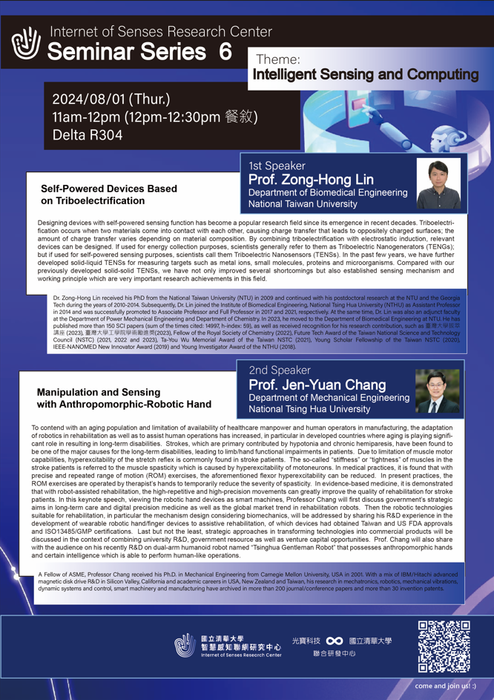
【其他】IoSRC的演講資訊
在此公告8月1日(四) IoSRC的演講資訊, 歡迎老師、同學報名參加。
欲報名者,請於 7/30(二)中午前填寫Google報名表單,以利後續安排,謝謝!
報名連結: https://forms.gle/VbpxamEWTAxicunv5
演講資訊如下:
時間: 8月1日(四) 11:00-12:00 (會後敬備餐點)
地點: 台達館 304室
Speaker 1 : 林宗宏教授 (Prof. Zong-Hong Lin, Department of Biomedical Engineering, National Taiwan University)
Title: Self-Powered Devices Based on Triboelectrification
Abstract: Designing devices with self-powered sensing function has become a popular research field since its emergence in recent decades. Triboelectrification occurs when two materials come into contact with each other, causing charge transfer that leads to oppositely charged surfaces; the amount of charge transfer varies depending on material composition. By combining triboelectrification with electrostatic induction, relevant devices can be designed. If used for energy collection purposes, scientists generally refer to them as Triboelectric Nanogenerators (TENGs); but if used for self-powered sensing purposes, scientists call them Triboelectric Nanosensors (TENSs). In the past few years, we have further developed solid-liquid TENSs for measuring targets such as metal ions, small molecules, proteins and microorganisms. Compared with our previously developed solid-solid TENSs, we have not only improved several shortcomings but also established sensing mechanism and working principle which are very important research achievements in this field.
Biography: Dr. Zong-Hong Lin received his PhD from the National Taiwan University (NTU) in 2009 and continued with his postdoctoral research at the NTU and the Georgia Tech during the years of 2010-2014. Subsequently, Dr. Lin joined the Institute of Biomedical Engineering, National Tsing Hua University (NTHU) as Assistant Professor in 2014 and was successfully promoted to Associate Professor and Full Professor in 2017 and 2021, respectively. At the same time, Dr. Lin was also an adjunct faculty at the Department of Power Mechanical Engineering and Department of Chemistry. In 2023, he moved to the Department of Biomedical Engineering at NTU. He has published more than 150 SCI papers (sum of the times cited: 14997, h-index: 59), as well as received recognition for his research contribution, such as 臺灣大學拔萃講座 (2023), 臺灣大學工學院學術勵進獎(2023), Fellow of the Royal Society of Chemistry (2022), Future Tech Award of the Taiwan National Science and Technology Council (NSTC) (2021, 2022 and 2023), Ta-You Wu Memorial Award of the Taiwan NSTC (2021), Young Scholar Fellowship of the Taiwan NSTC (2020), IEEE-NANOMED New Innovator Award (2019) and Young Investigator Award of the NTHU (2018).
Speaker 2 : 張禎元講座教授 (Prof. Jen-Yuan Chang, Department of Mechanical Engineering, National Tsing Hua University)
Title: Manipulation and Sensing with Anthropomorphic-Robotic Hand
Abstract: To contend with an aging population and limitation of availability of healthcare manpower and human operators in manufacturing, the adaptation of robotics in rehabilitation as well as to assist human operations has increased, in particular in developed countries where aging is playing significant role in resulting in long-term disabilities. Strokes, which are primary contributed by hypotonia and chronic hemiparesis, have been found to be one of the major causes for the long-term disabilities, leading to limb/hand functional impairments in patients. Due to limitation of muscle motor capabilities, hyperexcitability of the stretch reflex is commonly found in stroke patients. The so-called "stiffness" or "tightness" of muscles in the stroke patients is referred to the muscle spasticity which is caused by hyperexcitability of motoneurons. In medical practices, it is found that with precise and repeated range of motion (ROM) exercises, the aforementioned flexor hyperexcitability can be reduced. In present practices, the ROM exercises are operated by therapist's hands to temporarily reduce the severity of spasticity. In evidence-based medicine, it is demonstrated that with robot-assisted rehabilitation, the high-repetitive and high-precision movements can greatly improve the quality of rehabilitation for stroke patients. In this keynote speech, viewing the robotic hand devices as smart machines, Professor Chang will first discuss government's strategic aims in long-term care and digital precision medicine as well as the global market trend in rehabilitation robots. Then the robotic technologies suitable for rehabilitation, in particular the mechanism design considering biomechanics, will be addressed by sharing his R&D experience in the development of wearable robotic hand/finger devices to assistive rehabilitation, of which devices had obtained Taiwan and US FDA approvals and ISO13485/GMP certifications. Last but not the least, strategic approaches in transforming technologies into commercial products will be discussed in the context of combining university R&D, government resource as well as venture capital opportunities. Prof. Chang will also share with the audience on his recently R&D on dual-arm humanoid robot named "Tsinghua Gentleman Robot" that possesses anthropomorphic hands and certain intelligence which is able to perform human-like operations.
Biography: A Fellow of ASME, Professor Chang received his Ph.D. in Mechanical Engineering from Carnegie Mellon University, USA in 2001. With a mix of IBM/Hitachi advanced magnetic disk drive R&D in Silicon Valley, California and academic careers in USA, New Zealand and Taiwan, his research in mechatronics, robotics, mechanical vibrations, dynamic systems and control, smart machinery and manufacturing have archived in more than 200 journal/conference papers and more than 30 invention patents